
Your openEHR data, ready for the European Health Data Space.
The European Health Data Space (EHDS) requires health data to be exchanged in the European electronic health record exchange format, which is being specified on HL7 FHIR. openFHIR exposes what is already in your openEHR repository as FHIR, without replacing the repository.
The deadlines and the format.
The EHDS regulation introduces the European electronic health record exchange format (EEHRxF) and makes it mandatory for a set of priority data categories. The regulation itself does not name a standard, but the specifications being prepared for it by the Xt-EHR joint action and HL7 Europe are built on HL7 FHIR.
-
March 2027The regulation applies
The regulation applies from 26 March 2027. The implementing acts with the technical specifications of the exchange format are due by the same date.
-
March 2029First data categories
From 26 March 2029 the exchange rules cover patient summaries, ePrescriptions and eDispensations.
-
March 2031Second data categories
From 26 March 2031 they extend to medical images, laboratory and other test results, and discharge reports.
Dates as set in Regulation (EU) 2025/327.
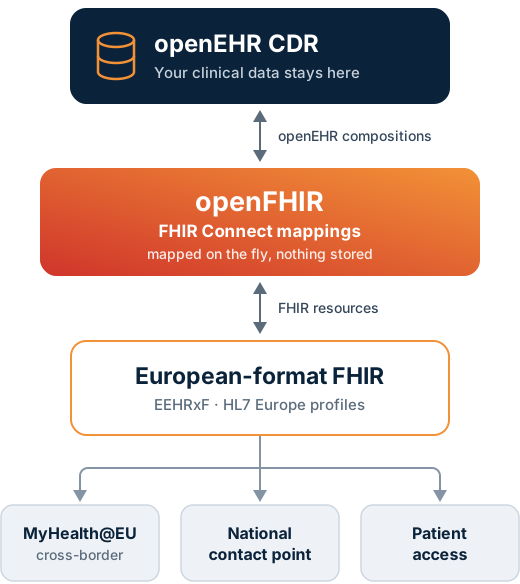
openEHR inside, European FHIR outside.
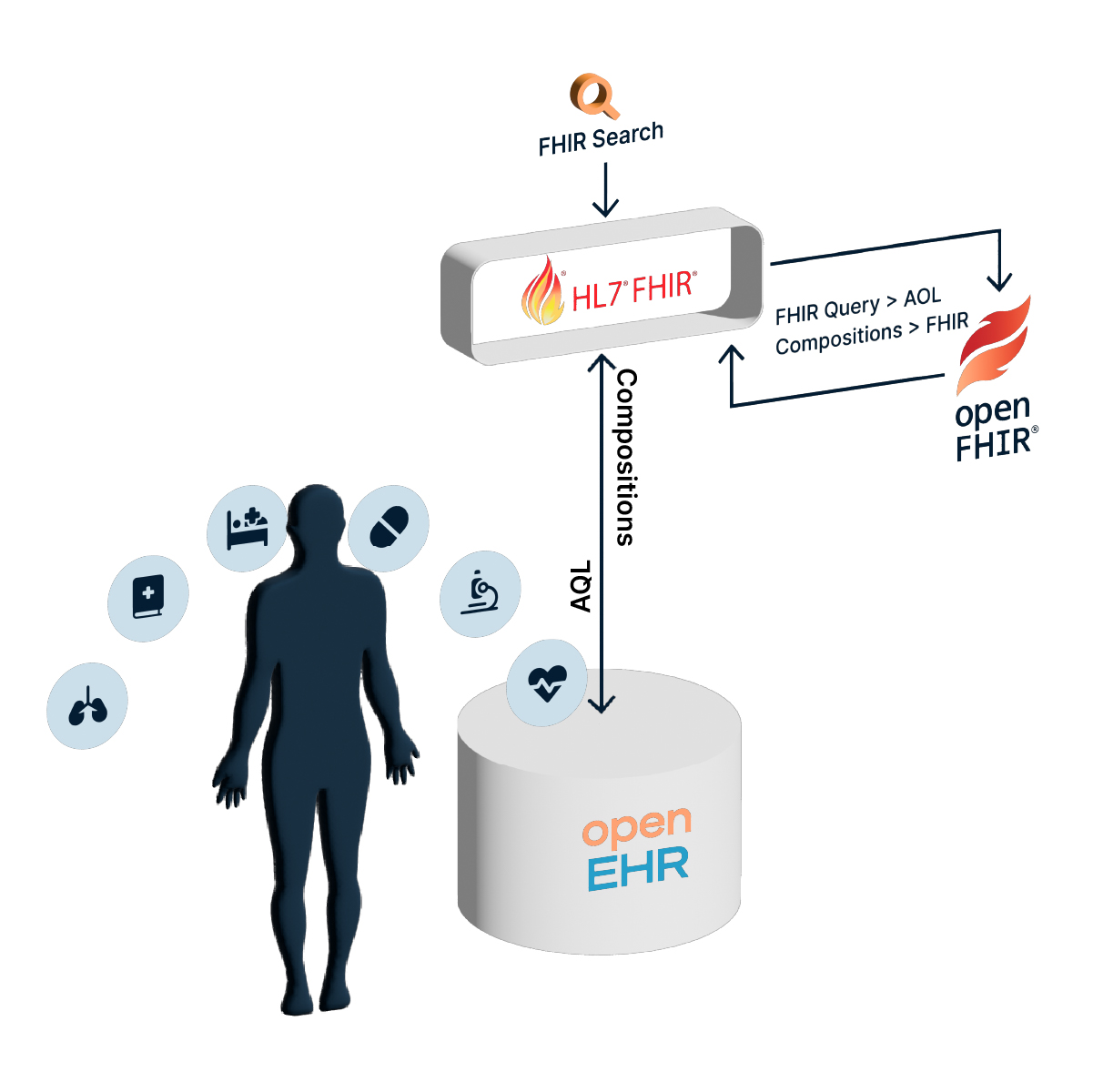
openFHIR sits next to your openEHR clinical data repository (CDR) and translates on request. Your data model, your queries and your applications stay as they are.
your data stays in your openEHR CDR, with no migration and no second copy
open FHIR Connect mappings produce the European FHIR profiles
one mapping works in both directions, so incoming cross-border data can land in openEHR
mapping happens on the fly, and openFHIR stores no patient data
runs next to any setup, with REST and message queue integration
Who it is for
Three kinds of organisation face the same gap between an openEHR repository and the European exchange format.
Hospitals and care providers
Meet the exchange obligations with the repository you already run. Your openEHR CDR stays the system of record, and the FHIR that EHDS asks for is produced from it on request.
National and regional programmes
Connect an openEHR platform to MyHealth@EU and national contact points using open, inspectable mappings that clinical modellers and auditors can read.
openEHR CDR vendors
Ship the interoperability building block with your CDR instead of building and maintaining a FHIR facade yourselves.
Already running, not a roadmap item.
Working setups and published mappings you can open and inspect.

Patient summary demo on openEHR
A live International Patient Summary (IPS) served as FHIR from data held in openEHR. The European Patient Summary builds on IPS, so this is the closest working preview of the first EHDS data category.

European Patient Summary mappings
freshEHR, on behalf of Nictiz, analysed the fit and gaps between the six core concepts of the European Patient Summary and the international openEHR archetypes, and wrote FHIR Connect mappings for them that run on openFHIR.

ZIB-EHDS hackathon
Dutch ZIB-based FHIR data goes into openEHR and comes back out as an AllergyIntolerance that follows the EHDS European Patient Summary profile. The setup is public and can be reproduced with Docker.

Mappings in openEHR CKM
The openEHR Clinical Knowledge Manager can publish FHIR Connect mappings alongside the archetypes they map, so mappings are shared and governed together with the clinical models.

IHE and openEHR plugathon
At the plugathon, an openEHR CDR with openFHIR in front of it acted as IHE document sharing infrastructure for patient summaries.
What openFHIR covers, and what stays with you.
EHDS puts several obligations on EHR systems and on the organisations that run them. openFHIR addresses the interoperability part: getting openEHR data in and out as European-format FHIR. It does not make a system meet EHDS on its own, and the rest remains with you or your EHR vendor.
openFHIR covers
- European-format FHIR produced from the data in your openEHR CDR
- Both directions: openEHR to FHIR, and incoming FHIR to openEHR
- Terminology mapping through a terminology server (Enterprise edition)
- FHIR versions from STU3 to R5
- Mappings kept as files you can version in Git, so a change in the specifications is a mapping update
Stays with you or your EHR vendor
- The European logging component
- Conformity assessment and CE marking of the EHR system
- Patient access services
- Consent and opt-out handling
- National connectivity: the link to your national contact point and its identity and access rules
Questions about EHDS
Something we have not covered?
Not by name. The regulation defines a European electronic health record exchange format and leaves its technical specifications to implementing acts, which are due by 26 March 2027.
The specifications being prepared for those acts are built on FHIR: the Xt-EHR joint action works with HL7 Europe, whose implementation guides include the European Patient Summary. Planning for FHIR is the practical reading.
No. EHDS sets the format in which data is exchanged, not the way you store it. Your openEHR CDR remains the system of record, and openFHIR translates at the boundary.
The patient summary is the furthest along. There is a working IPS demo on openEHR and there are published FHIR Connect mappings for European Patient Summary concepts such as allergies, problems, procedures and medical devices.
The engine itself is not tied to a data category. Any category can be covered once there is an openEHR template, a target FHIR profile and a FHIR Connect mapping between the two, and we can help you write those mappings.
The European implementation guides are still being written and will keep changing. With openFHIR, everything that is specific to a profile lives in FHIR Connect mapping files, not in the engine. When a profile changes you update the mapping and deploy it. Your stored data is untouched, because it never left openEHR.
No. openFHIR stores mappings and its own configuration, nothing else. Clinical data is mapped on the fly and is not stored or cached.
Any openEHR CDR that exposes the standard openEHR REST API. openFHIR works with openEHR compositions and templates, not with a vendor's internals. Tell us which CDR you run and we will confirm the details.
Talk to us about your EHDS roadmap
Send us a few lines about your openEHR setup and what you have to deliver under EHDS. We will get back to you by email.
Prefer your own mail client? Write to info@open-fhir.com.
Planning for 2029? Start with your patient summary.
Tell us which openEHR CDR you run and which EHDS data categories you have to deliver. We will show you what the mapping work looks like.